
The Hidden Cost of Growing a Triad Business: Why Everything Feels Harder at 40 Employees Than It Did at 20
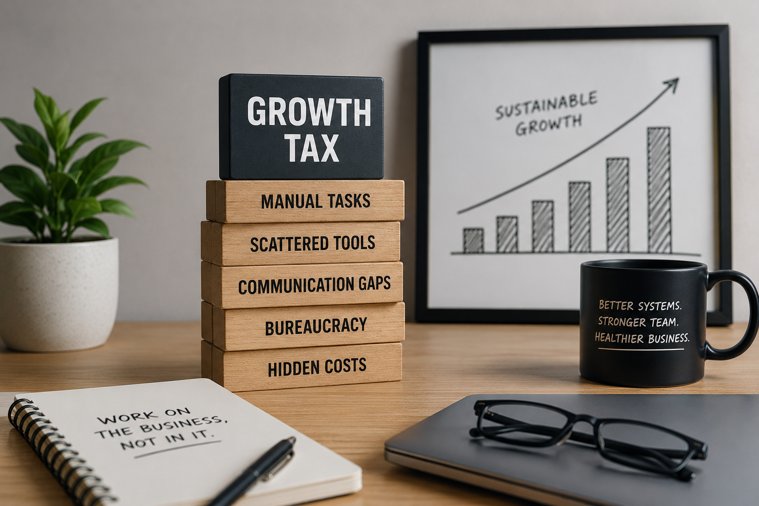
Here’s something nobody tells you about growing a business: at some point, the same systems that got you to where you are quietly start making the next stage harder.
At 20 employees, your tools work because everyone is close enough that gaps get filled by conversation. At 40, those gaps become real costs. Things that used to take an hour take a day. Decisions that used to happen in a hallway need a meeting and a follow-up email. Onboarding a new hire that used to be an afternoon becomes a two-week project nobody is fully managing.
Most owners I talk to assume the answer is more staff. Sometimes it is. More often, it’s not. The actual issue is what I call the hidden cost of growth.
What the hidden cost of growth actually is
The hidden cost of growth is the productivity drag that happens when your systems are still organized around how the business worked at an earlier stage. Tools that fit at one size start to chafe at another. Processes that worked when three people knew everything start to leak when twelve people each know a piece.
It’s hidden because you absorb it without seeing it directly. It comes out of your team’s time, your customer experience, your decision speed, and eventually your margin. And the worst part is that growth tends to mask the problem — when revenue is climbing, the friction shows up as “we’re just busy” rather than “our systems are out of alignment.”
After many years working with businesses across Greensboro, Winston-Salem, High Point, and Burlington, I can tell you with confidence: this hidden cost is one of the most expensive things in a scaling company, and almost nobody has it on their books.
Six ways it shows up
If you’re running a business between 20 and 100 employees and any of these feel familiar, you’re paying it.
1. The simple question that suddenly takes too long to answer. You ask, “How are we doing on Q2 projects?” Three years ago, you could answer that yourself in two minutes. Now it takes a meeting, a spreadsheet pull, and a follow-up email chain because the data lives in four places and nobody owns the consolidated view. That delay isn’t a personnel issue. It’s a systems issue.
2. Workarounds that became infrastructure. Someone built a shared spreadsheet during a busy season three years ago to bridge a gap between two systems. That spreadsheet is now load-bearing. Two people maintain it. New hires get trained on it. Nobody remembers why it exists, but everyone agrees it can’t break. That’s a workaround that grew up to become infrastructure, and it’s a quiet liability.
3. Tools that work — but only because someone is babysitting them. Your CRM is working. Your project tool is working. Your accounting system is working. But the only reason they’re all working together is that one person — usually a long-tenured employee — is manually keeping them aligned. The day that person takes vacation, you’ll find out exactly how fragile that bridge is.
4. Decisions that get harder because the picture isn’t clear. You’re considering whether to take on a bigger client, hire two more people, or open a second location. The decision feels harder than it should, and you can’t quite say why. Often, the reason is that your systems can’t easily tell you what you’d need to know to decide confidently. So decisions get postponed, or made with less information than they should have.
5. Onboarding that takes longer every year. Bringing a new employee up to speed used to take a week. Now it takes a month, and they’re still asking questions at month three. That’s a sign your environment has accumulated complexity faster than your documentation has kept up. The complexity isn’t optional — it grew with the business. The documentation gap is fixable.
6. The software bill that keeps creeping up without a clear reason. Last year’s monthly software spend is up 20% from the year before, and nobody can fully explain why. Some of that is real growth — more people need more licenses. But some of it is this hidden cost at work: redundant tools, expanding plans that haven’t been right-sized, subscriptions added during specific projects that never got removed.
Why this happens (and why it’s not your fault)
Here’s what makes this especially frustrating: every decision that led to it was reasonable when it was made.
You added the second project tool because the first one was awkward for one team. That was the right call at the time. You kept the legacy CRM because changing it would have disrupted the salespeople in a quarter where you needed every deal to close. That was also the right call. You let the workaround spreadsheet stay because it was working and tearing it out would have required somebody’s full attention. Right call.
The hidden cost doesn’t accumulate because anyone made bad decisions. It accumulates because reasonable past decisions, stacked on top of each other, eventually stop fitting the present business. The business outgrew the assumptions baked into the original choices.
That’s not a leadership failure. It’s just what happens when a business grows. The work isn’t avoiding this cost forever. The work is recognizing it and refactoring deliberately when it shows up.
How to stop paying it without rebuilding everything
The instinct, when business owners realize what growth is quietly costing them, is to want to fix everything at once. New tools. New processes. Big project. Lots of disruption.
Don’t do that. The cure is almost always worse than the disease.
What actually works is a structured look at what’s already in place, identifying the two or three highest-impact misalignments, and addressing those first. The rest of the system stays as-is. Once those changes settle, you assess again.
Practically, that means asking five questions, in this order:
- What does our team spend the most time working around? That’s where the highest cost is hiding. Fix that first.
- What does our current software inventory actually contain? Get the complete list in front of you. You probably haven’t seen all of it in one place in years.
- Which tools overlap? Where two systems handle similar functions, pick one. Consolidate.
- Which features in tools we already pay for would replace something else we’re buying? This is the most common hidden win. Microsoft 365 or your CRM probably already does something you’re paying another vendor to do.
- Who has access to what, and why? Reviewing this once a year is the floor. Most growing businesses are well overdue.
Five questions. None of them require buying anything. All of them generate findings that translate directly into recovered time, recovered money, and recovered decision speed.
What changes when you stop paying it
When a growing business actually addresses this hidden cost, the difference shows up in places nobody predicted at the start.
Onboarding gets faster because the environment is documented. The software bill stops creeping. Decisions get easier because the picture is clearer. The team stops developing workarounds because the underlying systems start working the way they were supposed to. And the owner — most importantly — stops feeling like the business is dragging on their leg even when revenue is growing.
That last one is the biggest win. Business owners I’ve worked with for years tell me the same thing after we work through this: the business doesn’t necessarily get easier, but it stops feeling heavier than it should be.
Ready to find out what growth is quietly costing you?
Schedule a free 15-minute IT Check. We’ll walk through your current environment, identify where the misalignments are quietly costing you, and give you a clear plan to address the highest-impact ones. Call us at (336) 904-9101 or visit solaceits.com.